


ESSAY | JULY 16, 2026
AI, Jevons events, and the uneven distribution of creative desire
Brian W. Penschow, AIA
AI is making creative capability radically cheaper, widening the field of who can make. But access does not distribute appetite equally: the decisive scarcity migrates from execution toward judgment, continuity, responsibility, and directed desire.
When Efficiency Opens the Field
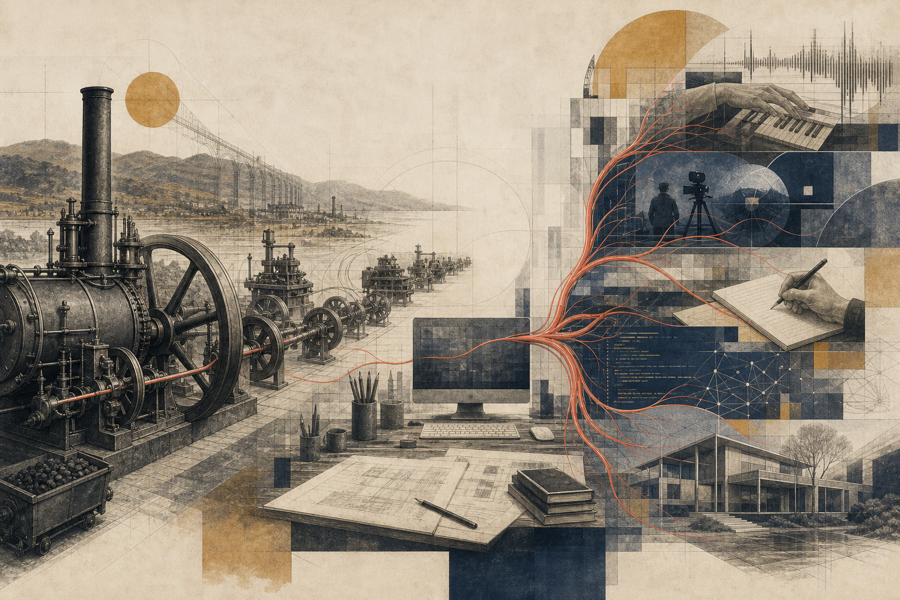
Efficiency changes more than cost. It enlarges the field of possible use.
AI is expanding human capability at extraordinary speed. Music production, image-making, film, software, writing, product design, and architectural visualization are all becoming cheaper to attempt. A person who once needed a studio, a crew, specialized equipment, years of technical training, and enough money to survive a long apprenticeship can now approach the same territory through an ordinary computer. The result will be an enormous increase in production. We will make more songs, images, stories, animations, models, applications, and speculative buildings because each attempt consumes less money, less labor, and less time. That much is nearly mechanical. Once the price of an action collapses, people perform more of it.
This is the pattern William Stanley Jevons identified in The Coal Question in 1865. Engineers had made steam engines more efficient, so each engine could perform more work with less coal. A simple conservation argument suggested that Britain would therefore burn less coal. Jevons saw the opposite mechanism. Greater efficiency made steam power more economical, which expanded the number of profitable uses for engines. Industry installed more engines, entered more markets, and consumed more coal in total. Efficiency did not merely improve an existing practice. It enlarged what Jevons called the field of operations.
The Jevons paradox properly belongs to economics and resource consumption. It should not be pasted carelessly onto every technological change. Still, the mechanism gives us a useful way to understand creative capability. When a unit of cognition, production, or iteration becomes radically cheaper, demand does not remain fixed. We do not make the same number of things for less. We test ideas that could never have justified the old price. We cross thresholds that once protected entire professions. We invent uses that were irrational under the previous cost structure. I think of these threshold changes as Jevons events: moments when efficiency enlarges the field so dramatically that an activity changes in kind as well as scale.
AI is such an event. The immediate mistake is to confuse an enlarged field with universal migration into it. The gates open, traffic increases, and new settlements appear, but most people do not abandon every place they already inhabit. Cheap capability invites everyone. It does not give everyone the appetite to enter, and it certainly does not give everyone the desire to remain.
Abundance Does Not Produce Equal Participation
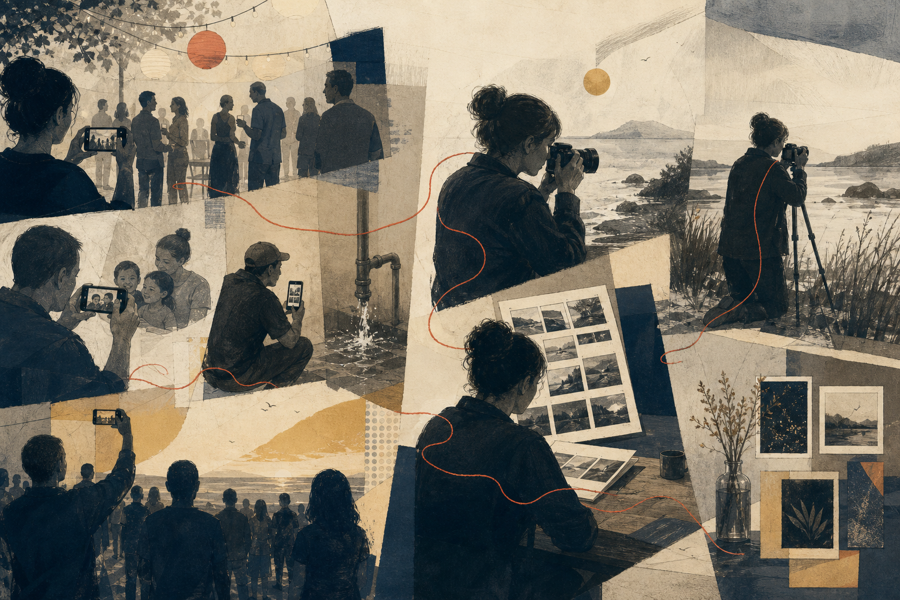
Universal access creates a civilization that takes photographs—not universal devotion to photography.
Photography has already run this experiment several times. Nineteenth-century photography required cumbersome equipment, chemical knowledge, money, patience, and control over a process that could fail for reasons invisible until development. Kodak separated picture-taking from much of the chemistry, and the Brownie camera reduced the price of admission to one dollar in 1900. The snapshot followed. Families who would never have commissioned a formal portrait began recording picnics, children, vacations, disasters, military service, and ordinary rooms. Digital cameras later removed film and processing costs. Smartphones then placed a competent camera in billions of pockets and reduced the marginal cost of another photograph to nearly zero.
Total photography exploded, exactly as the Jevons mechanism would predict. Yet universal access to a camera did not turn humanity into a civilization of devoted photographers. It created a civilization that takes photographs. Those are different conditions. The National Endowment for the Arts found that 13 percent of American adults took photographs for artistic purposes in 2022, even though camera access was effectively ubiquitous. Most photographs serve memory, communication, proof, identity, flirtation, status, or the practical need to show someone which pipe is leaking under the sink. Only a minority become part of a sustained visual inquiry. The camera became universal. The photographer did not.
The same distinction appeared when desktop publishing collapsed the old separation among writing, typesetting, page composition, and printing. A modest computer eventually gave one person powers that had belonged to a coordinated production chain. Blogs and social platforms then removed most distribution costs. Every connected person acquired something close to a private printing press, yet most people did not become essayists, reporters, novelists, or editors. They wrote messages, captions, comments, reviews, and occasional posts because writing had become embedded in ordinary life. A smaller group accepted the harder invitation: to develop an argument over thousands of words, build a body of work, revisit sentences after the pleasure of first expression had passed, and publish often enough to discover what they actually thought.
Cheap entry therefore creates layers of behavior. At the broadest layer, people use the capability incidentally. Above that, many dabble because the first attempt has become easy and entertaining. A smaller number form a practice. Fewer still reorganize their lives around the new power and begin connecting it to powers they already possess. The numerical base can become enormous while the upper layers remain thin. This is not a failure of democratization. It is what democratization reveals once exclusion no longer explains all of the difference.
Music, Film, and Code After the Price Collapse
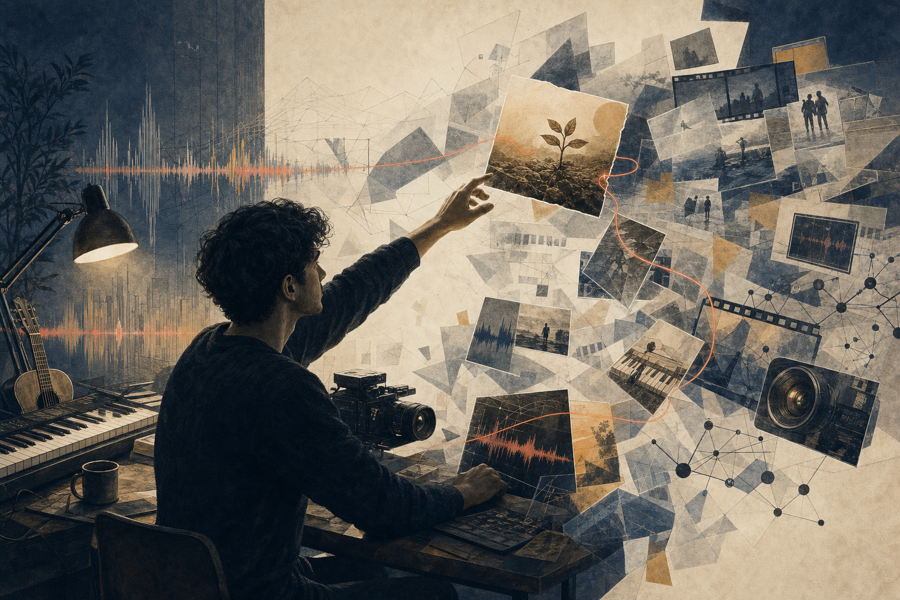
When production becomes cheap, the burden moves toward selection.
Recorded music once demanded an expensive convergence of scarce resources. Musicians needed instruments, rehearsal space, microphones, tape, engineers, studio time, manufacturing, distribution, and access to institutions capable of putting a record into stores or onto radio. Digital audio workstations steadily compressed that apparatus into software. Distribution platforms removed the need to manufacture a physical object before anyone could hear the work. AI now makes another violent reduction in cost. A person without instrumental technique can describe a musical territory, generate variations, alter the emotional temperature, combine clarinet jazz with electronic dance music, or place Spanish guitar inside a sound world it has never occupied before.
This will produce an avalanche of music. Spotify already offers more than 100 million tracks to hundreds of millions of listeners, a scale that would have been physically absurd in the record-store era. AI will increase the catalog faster than any listener can comprehend it. Yet listening and authorship will remain psychologically distinct. The person who wants music for a morning at work may generate three tracks, choose one, and never return to the process. Another person will hear an unexpected interval in the failed second track and spend the afternoon following it through twenty mutations. The technology is identical. The relationship to the unresolved possibility is not.
Film and video show the same structure. Affordable cameras, nonlinear editing, free distribution, and global platforms made broadcast capability available outside studios and networks. YouTube now has more than three million channels in its Partner Program and supports a large creator economy, but the striking fact is not that millions create. The striking fact is that billions can. Most viewers remain viewers. Many upload a few fragments. Some develop a channel for a season and discover that wanting attention is not the same as wanting production. A durable filmmaker must repeatedly choose a frame, rhythm, performance, cut, sound, and point of view. Lower prices remove many excuses, but they do not remove the accumulating burden of choice.
Software has moved through its own sequence of Jevons events. Personal computers made computation available outside governments and corporations. The internet made distribution nearly free. Open-source libraries allowed developers to begin with inherited components rather than raw machine instructions. Cloud services turned infrastructure into something rented by the minute. AI coding systems now let people describe an application in ordinary language and receive working code. GitHub reports hundreds of new repositories created every minute, evidence that the field of operations is enlarging again. Still, a repository is not a durable product. The difficult work migrates toward deciding what should exist, understanding whom it serves, recognizing failure, maintaining the system, and remaining responsible when other people begin depending on it.
Architecture and the Migration of Scarcity
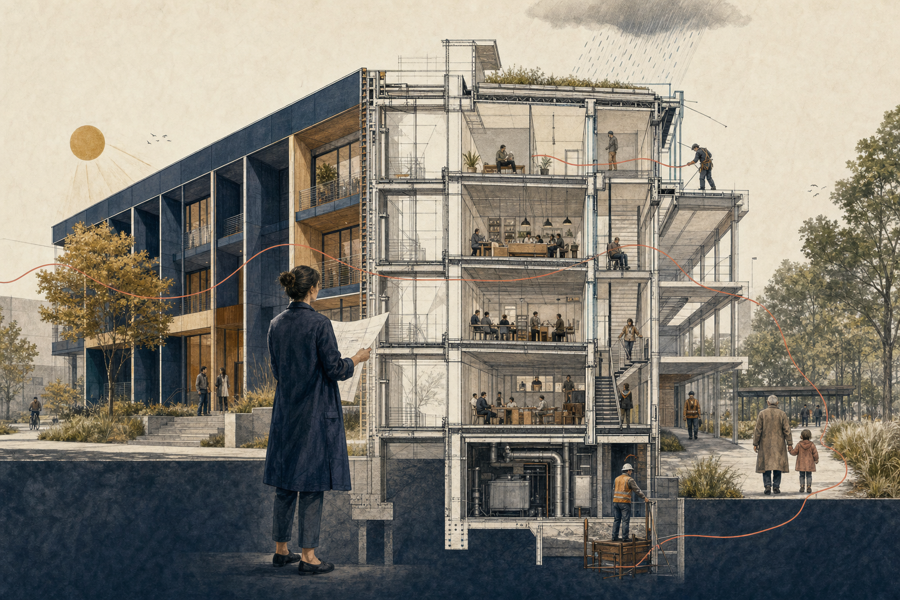
The tool can make form inexpensive. It cannot make consequence inexpensive.
Architecture knows this pattern intimately because the profession has spent decades absorbing technologies that promised to eliminate labor. Computer-aided drafting made lines faster to produce, duplicate, revise, and coordinate. Building information modeling connected geometry to information and allowed one change to propagate through multiple views. Parametric systems produced families of alternatives that would have been punishing to draw manually. Autodesk has reported substantial productivity gains for common architectural drafting tasks, yet firms did not respond by issuing the same modest drawing sets with fewer hours. Sets became larger, coordination became more granular, clients expected more visualization, and teams tested more alternatives. The labor saved at one level reappeared as expanded scope at another.
AI will intensify this migration. A client may generate a plausible house, school, lobby, or hospital room before speaking to an architect. That does not make the exercise meaningless. The image may reveal a real preference or expose a possibility that conventional programming would have missed. It also does not make the client an architect. Architecture begins where the attractive image collides with gravity, water, fire, accessibility, energy, structure, procurement, labor, law, maintenance, politics, human behavior, and the consequences of occupying a decision for fifty years. The tool can make form inexpensive. It cannot make consequences inexpensive.
This is what every Jevons event does to expertise. It destroys one scarcity and exposes another. When drafting is expensive, the ability to draft controls entry. When drafting becomes cheap, coordination, judgment, and responsibility become more visible. When rendering is expensive, the ability to produce one persuasive image carries power. When images become limitless, the ability to identify the honest image becomes scarce. When a music studio is expensive, access decides whose songs can be recorded. When a studio fits inside a prompt, the scarcity moves toward taste, continuity, and the capacity to hear what is missing.
AI is often described as a replacement for creative labor because it makes execution cheap. That diagnosis stops one floor too low. Cheap execution increases the number of executions. It also increases the amount of selection, direction, verification, integration, and rejection required to find meaning inside the abundance. The future creator may fabricate less by hand while making more consequential decisions. The work begins to resemble breeding: generate variations, observe traits, preserve the living deviation, cross it with another line, and kill most of the results. Anyone can produce one hundred options. The rare faculty is the breeder’s eye that recognizes which damaged, incomplete option contains a future.
The Human Rebound
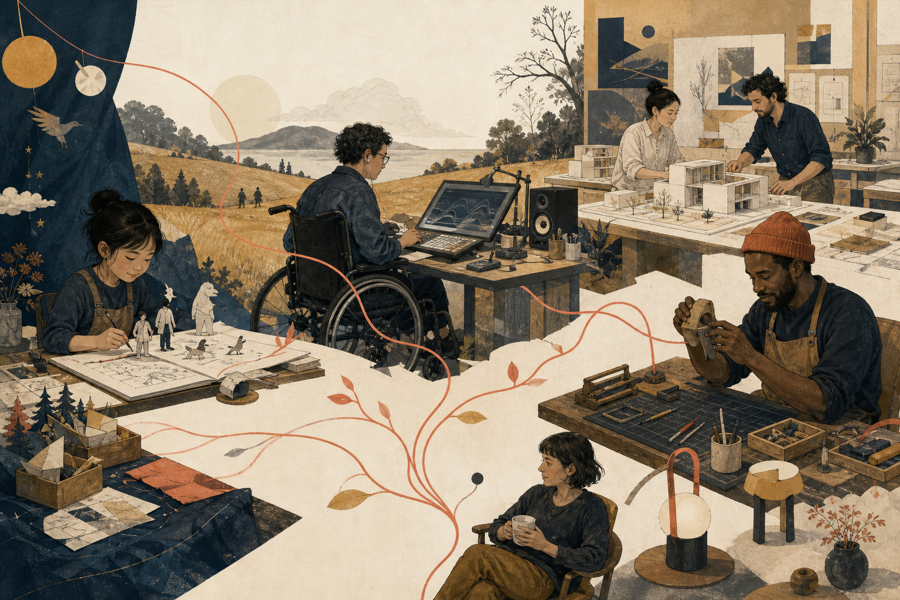
Cheap attempts release work the old economy prevented us from seeing.
Economic accounts of Jevons effects usually measure the rebound in consumption. Creative Jevons events produce a human rebound as well. When the cost of an attempt falls, suppressed curiosity becomes action. A person who always wanted to score a film can hear an approximation. Someone with no access to a machine shop can prototype an object. A child can animate a private mythology. A disabled creator can bypass a physical or procedural barrier that once closed an entire medium. A small practice can test an architectural idea without purchasing the production capacity of a large firm. These are not counterfeit achievements. The opening of the field is real, and it will release work that the old economy prevented us from seeing.
The opening will not affect everyone in the same way. For many people, AI will become a more responsive form of consumption. They will request a song fitted to an evening, an image fitted to a joke, a story fitted to a child, or a room fitted to a mood. Their role will be participatory but brief. They will choose, enjoy, and move on. The abundance will satisfy them because the desired object was always the point. They wanted the song, not a relationship with composition; the picture, not a life spent learning to see; the room, not the thousand interdependent decisions that make shelter responsible.
Others will discover that the first output makes the desire worse. A generated song will not satisfy them because it reveals five other songs hiding behind it. The image will expose a visual language they had not known how to name. A piece of code will suggest a tool, which will reveal a system, which will expose a neglected institution that could be rebuilt. Each cheap result creates more demand for cognition rather than closing the transaction. This is the true creative rebound. Efficiency enlarges not only production but appetite.
A much smaller group responds differently. When capability becomes cheap, these people enter repeatedly and across boundaries. They do not see music, images, software, architecture, and writing as sealed professions. They see distinct instruments for investigating the same world. A musical experiment teaches them something about rhythm that changes a paragraph. A visual error reveals a spatial relationship that returns in a building. A coding problem clarifies an institutional process. They use each medium to interrogate the others, and the value lies increasingly in the crossings.
We usually call these people visionaries, although the word has been weakened by corporate theater. A visionary is not someone who predicts the future with supernatural accuracy or performs confidence on a stage. The visionary recognizes a newly opened field before its customs harden, then stays long enough to discover what the field permits. Vision requires sight, but it also requires the less glamorous capacity to continue after recognition. Plenty of people glimpse a possibility. Few reorganize their practices around it.
The Visionary Minority
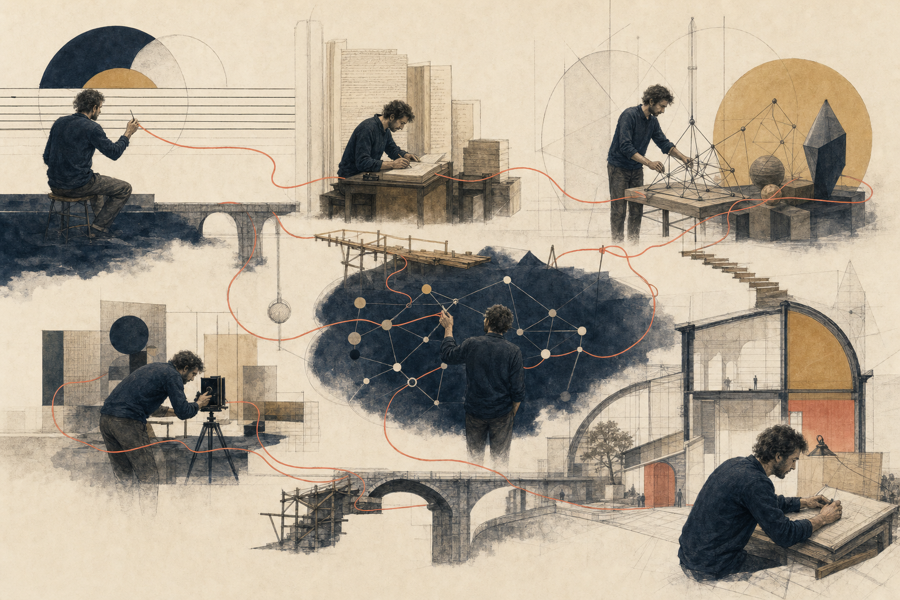
The value moves increasingly into the crossings.
History remembers visionaries as if their ideas arrived intact. In reality, they tended to be promiscuous users of whatever capabilities their moment made available. The printing press did not make everyone an author, but it allowed certain writers, scientists, theologians, and political organizers to build systems of influence impossible under manuscript scarcity. Photography did not make everyone a visual artist, but it gave a minority a new way to document time, construct identity, expose power, and alter public memory. Personal computing did not make everyone a programmer, but a relatively small group saw that the machine could become a medium rather than merely a calculator. The decisive act was not gaining access. It was perceiving a larger field of operations inside the access.
AI gives that minority an unusual advantage because it cheapens movement among domains. Earlier polymaths paid heavily for every crossing. They needed another apprenticeship, another shop, another set of collaborators, or another patron willing to finance the detour. Their curiosity encountered the full infrastructure cost of each medium. AI does not abolish expertise, but it provides a provisional bridge. It lets a serious beginner make contact with a field quickly enough to determine whether a deeper relationship exists. For the person with broad and focused desire, this is not convenience. It is the recovery of parts of the self that specialization forced into dormancy.
That recovery will look excessive from the outside. The visionary will appear unable to leave the tools alone. Give such a person a music generator and the afternoon disappears into hybrid forms no market requested. Give them an image system and they begin constructing visual worlds. Give them a language model and they do not merely ask for answers; they build methods, arguments, characters, workflows, and instruments for further thought. Their output may include failures, indulgences, and a great deal that nobody else needs. Jevons events always produce waste along with discovery because cheap attempts remove the discipline imposed by high cost. The visionary’s task is not to avoid abundance. It is to develop selection strong enough to survive it.
This is why the ability to generate cannot be the final competitive advantage. Generation will become ambient. Taste will matter, but even taste is too passive a word because it suggests preference after the fact. The deeper advantage is directed desire: the ability to form an intention, remain with it, recognize what the work is becoming, and revise the intention without losing the thread. It combines appetite with judgment. Without appetite, the person stops. Without judgment, the person floods the field with undifferentiated output. Without continuity, every experiment remains a novelty.
The strongest creators will also accept responsibility for selection. When production was expensive, cost performed some of that selection brutally and unfairly. Studios, publishers, schools, firms, and patrons decided which attempts could exist. Their gates excluded enormous talent, but they also limited volume. As those gates weaken, the creator inherits more of the editorial burden. Nobody prevents the two-hundredth image, the fiftieth mix, the ninth version of the essay, or the unnecessary building concept. The visionary must become both fertility and restraint, generating widely and cutting without sentimentality.
Everybody Can. Few Will.
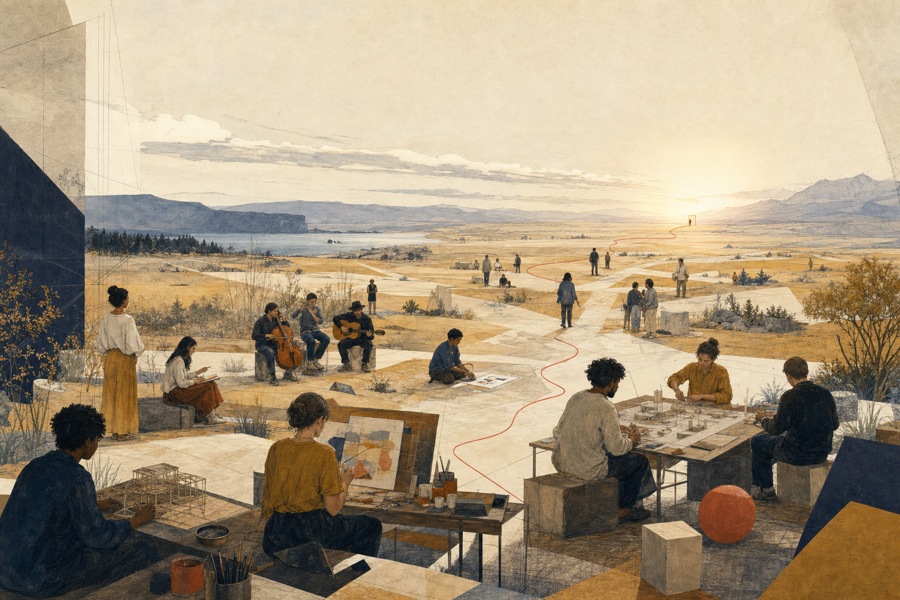
Access opens the field. Directed desire determines who continues.
We tend to project our own motivational structure onto everyone else. A person with strong creative hunger encounters a new capability and immediately imagines what can be made with it. Because the response feels natural, almost involuntary, they assume the same hunger will spread with the tool. It will not. Capability and behavior are connected through desire, and desire is distributed unevenly. Access changes the population of possible creators. It does not make authorship a universal human priority.
I know which side of that distinction I inhabit. When AI gives me the ability to make music in the afternoon, I want to make music. When it opens a path into visual art, I want to follow it. When it lets me test language, architectural ideas, systems, images, and unfamiliar combinations more rapidly, I do not experience the new efficiency as permission to do less. I experience it as an enlarged field of operations. The cheaper each iteration becomes, the more iterations I can see waiting behind it.
That response is not superior to consumption, and it is not a moral obligation for everyone else. Audiences complete culture. Listeners animate music, readers reconstruct books inside consciousness, and occupants give architecture its actual life. The mistake lies in assuming that love of an experience naturally becomes a desire to originate one. Most people will use AI to bring the world toward them. A few will use it to push more of themselves into the world.
AI will therefore create more makers without making everyone a maker, just as cheap photography created more photographs without creating universal devotion to photography. It will allow millions of new entrants while preserving a steep gradient between access, experimentation, practice, and sustained authorship. The most important division will not fall between people who possess the technology and people who do not. It will fall between those for whom the output closes the appetite and those for whom it opens another door.
Everybody can. Few will continue. Fewer will cross repeatedly into unfamiliar forms, combine them, and accept the burden of deciding what deserves to remain. Those are the visionaries, not because a machine gives them vision, but because reduced friction allows their existing Eros to move. Their drive toward life, connection, expression, and creation converts every cheaper capability into another demand: one more version, one more crossing, one more attempt to increase what the world contains.
ABOUT THE AUTHOR
Brian W. Penschow, AIA, is an architect, construction-specifications expert, writer, and AI systems builder whose work examines the crossings among design, technology, creative practice, and responsibility.
Source Note
The historical account of the Jevons paradox draws on William Stanley Jevons, The Coal Question (1865), particularly his chapter “Of the Economy of Fuel.” The photography discussion draws on the Smithsonian Institution Archives and National Science and Media Museum histories of the Kodak Brownie, together with the National Endowment for the Arts, Arts Participation Patterns in 2022. Current platform scale is drawn from Spotify’s company information and Loud & Clear reporting, YouTube’s published Partner Program figures, GitHub’s 2025 Octoverse, and Autodesk’s reporting on architectural CAD productivity. Platform figures describe scale, not independent measures of artistic commitment, and are used here only to show how sharply production and distribution capacity have expanded.