East Coast Green Virtual Conference
East Coast Green Virtual Conference
img+strong, strong+img {padding-top: 40px; display: block;}img.alignleft.size-thumbnail { margin-bottom: 20px;}h3 b {color:#000;}
Join the AIA-NJ Committee on the Environment at the AIA NJ East Coast Green Virtual Conference to shape the future of architecture and sustainability. This premier event gathers industry leaders, architects, and innovators to explore cutting-edge solutions and sustainable practices. Don’t miss your chance to be part of this transformative experience. Register now to engage with key experts and gain insights into the latest advancements in sustainable design.
Don’t miss out on driving the change towards a greener tomorrow!
Up to 13 credits available.
10:00 AM: ESG: What is it and how do design professionals fit in?
1 LU
 Erica Godun, AIA, LEED AP BD+C, WELL AP, Fitwel
Ware Malcomb
View Session Description
<!–
ESG (Environmental, Social, Governance) is more than a passing trend—it’s a transformative framework that is profoundly reshaping the built environment. As environmental concerns, social responsibility, and governance standards become more prominent, ESG is emerging as a critical component in the design and construction industry. This session, led by Erica Godun, Director of Sustainability at Ware Malcomb, offers a deep dive into how these principles intersect with architecture and design, providing valuable insights for professionals at all levels.
–>
11AM EST: Our Journey to a Sustainable Material Design Standard
1 LU/HSW
Jessica Palmer, AIA, LEED AP BD+C
Gensler
Vivian Lawler
Gensler
View Session Description
<!–
In the design and construction sector, sustainability and resilience have long been a focus, yet concerns over cost often overshadow the imperative of reducing our carbon footprint. With the built environment responsible for approximately 40% of global carbon emissions, it’s crucial that we take ownership of our role in decarbonization. One effective strategy for reducing emissions is through thoughtful materials selection. Architects and designers have a significant impact on climate change, with their choices influencing carbon emissions far more than the average consumer. In response, Gensler has developed the Gensler Product Sustainability Standards (GPS) v1.1, a comprehensive framework aimed at promoting accountability and accelerating the adoption of sustainable materials. GPS v1.1 provides clear standards for both designers and manufacturers, aligning with industry guidelines and pushing for more ambitious targets. Created in collaboration with manufacturers, industry groups, and third-party certifications like mindful Materials Common Material Framework, Carbon Leadership Forum, BIFMA, LEED, BREEAM, and Living Building Challenge, this evergreen standard focuses on high-volume, market-ready materials. Join us as we explore how the architecture and design sector, alongside its partners, can leverage GPS v1.1 to meet decarbonization goals and transform the global system of building materials, from local projects to international initiatives.
–>
1PM EST: The Future of Energy: A New Home for Energy Research at the Vagelos Laboratory for Energy Science and Technology
1 LU/HSW
Erik Hegre, AIA NCARBBehnisch Architekten
Michelle Lee
Behnisch Architekten
View Session Description
<!–
This session will present a case study of the Vagelos Laboratory for Energy Science and Technology at the University of Pennsylvania, a new facility dedicated to clean energy research. Transforming a former parking lot into a gateway for energy research, the project incorporates a multi-faceted approach to create an energy-efficient building that enhances the quality of life for its users and surrounding community. The session will explore the urban and historic forces shaping the site strategy, which includes linking East and West Philadelphia through new transport modes and utilizing the Mid-Atlantic climate for natural ventilation. The session will also delve into the bespoke design of the building’s envelope, featuring a fixed sun-shading system made of tensioned ETFE fabric, tailored for the site’s exposure and providing optimal daylit research environments. The presentation will cover the collaborative design process involving faculty, climate engineers, and lighting consultants, including analog lighting studies, climate software modeling, and Life Cycle Assessments of façade materials. Emphasizing passive, low-energy design strategies, the VLEST integrates technical innovations such as reduced laboratory air flow rates and high-efficiency heat recovery to support the university’s carbon neutrality goal by 2042.
–>
2PM EST: Designing Livable, Affordable, Low Carbon Communities
1 LU/HSW
Michael Eliason
Larch Lab
View Session Description
<!–
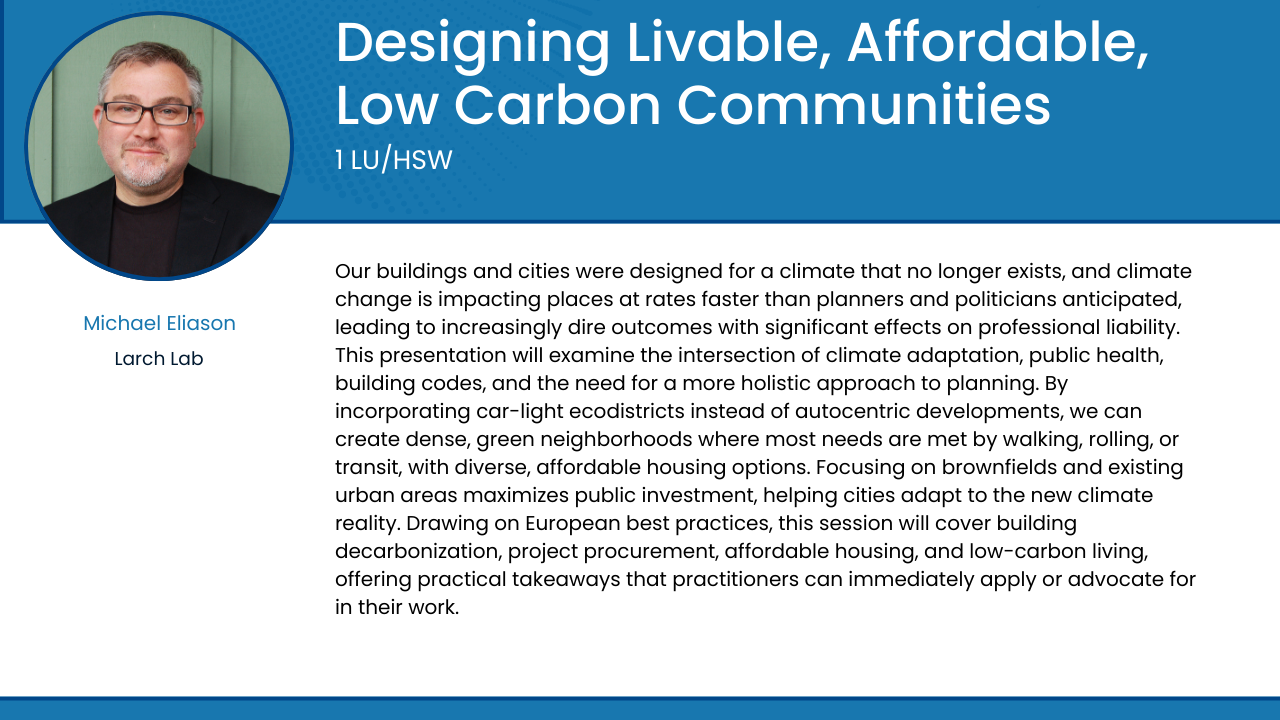
Our buildings and cities were designed for a climate that no longer exists, and climate change is impacting places at rates faster than planners and politicians anticipated, leading to increasingly dire outcomes with significant effects on professional liability. This presentation will examine the intersection of climate adaptation, public health, building codes, and the need for a more holistic approach to planning. By incorporating car-light ecodistricts instead of autocentric developments, we can create dense, green neighborhoods where most needs are met by walking, rolling, or transit, with diverse, affordable housing options. Focusing on brownfields and existing urban areas maximizes public investment, helping cities adapt to the new climate reality. Drawing on European best practices, this session will cover building decarbonization, project procurement, affordable housing, and low-carbon living, offering practical takeaways that practitioners can immediately apply or advocate for in their work.
–>
3PM EST: Green Building Cash Incentives
1 LU
Alexis MartinCEO of EPSA
Jake QuastEPSA
View Session Description
<!–
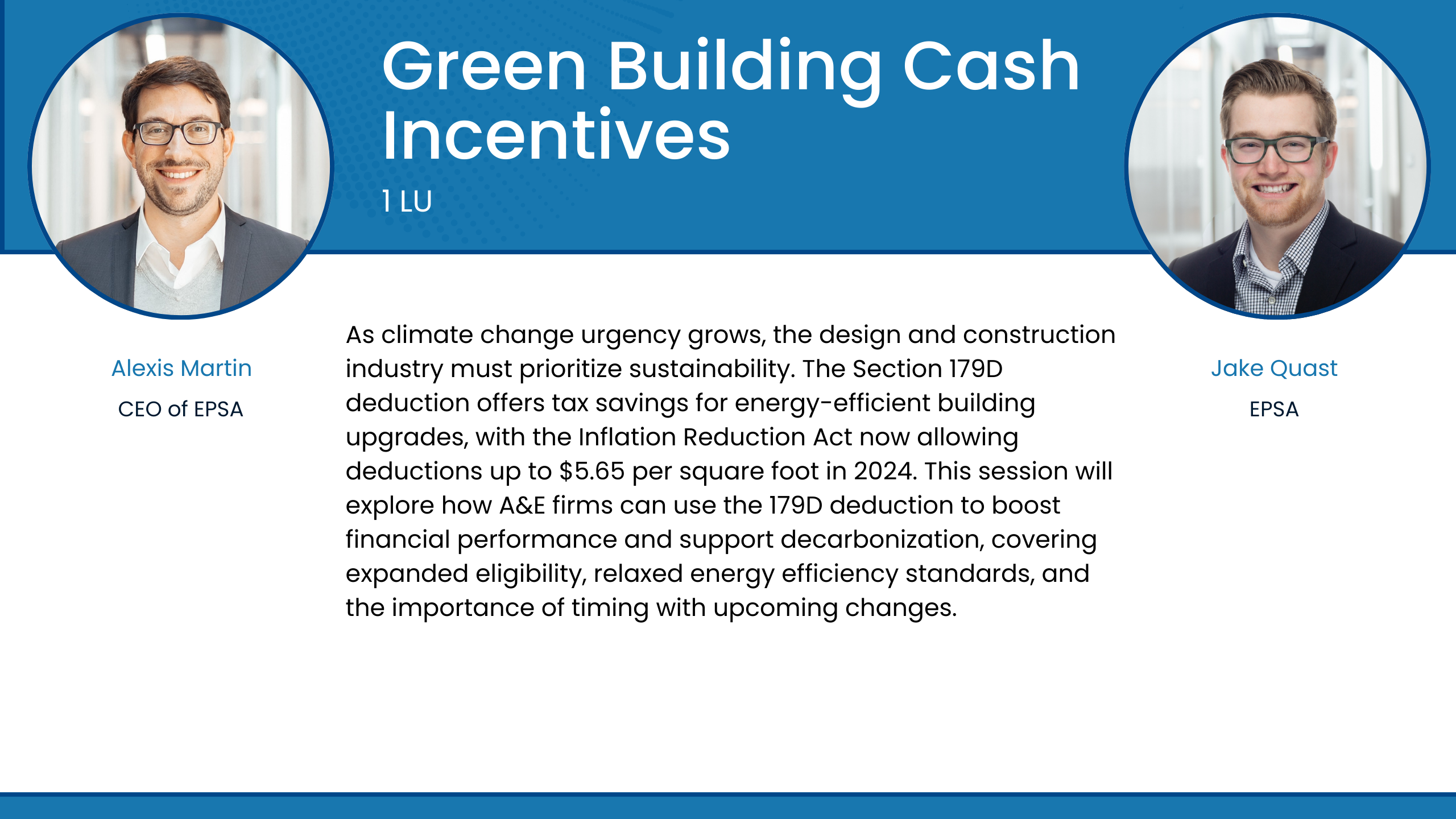
As climate change urgency grows, the design and construction industry must prioritize sustainability. The Section 179D deduction offers tax savings for energy-efficient building upgrades, with the Inflation Reduction Act now allowing deductions up to $5.65 per square foot in 2024. This session will explore how A&E firms can use the 179D deduction to boost financial performance and support decarbonization, covering expanded eligibility, relaxed energy efficiency standards, and the importance of timing with upcoming changes.
–>
4PM EST: Future Proof Your Practice
1 LU
 Marc Mondor, AIA, LEED Fellow, USGBC Faculty, WELL APPrincipal, evolve
View Session Description
5PM EST: Zero Waste Mixology: Using Locally Sourced or Leftover Ingredients to Create Spirts and Cocktails with a Low Carbon Footprint
1 LU
Jason Takeuchi, AIA, NCARB, NOMAFerraro Choi And Associates
View Session Description